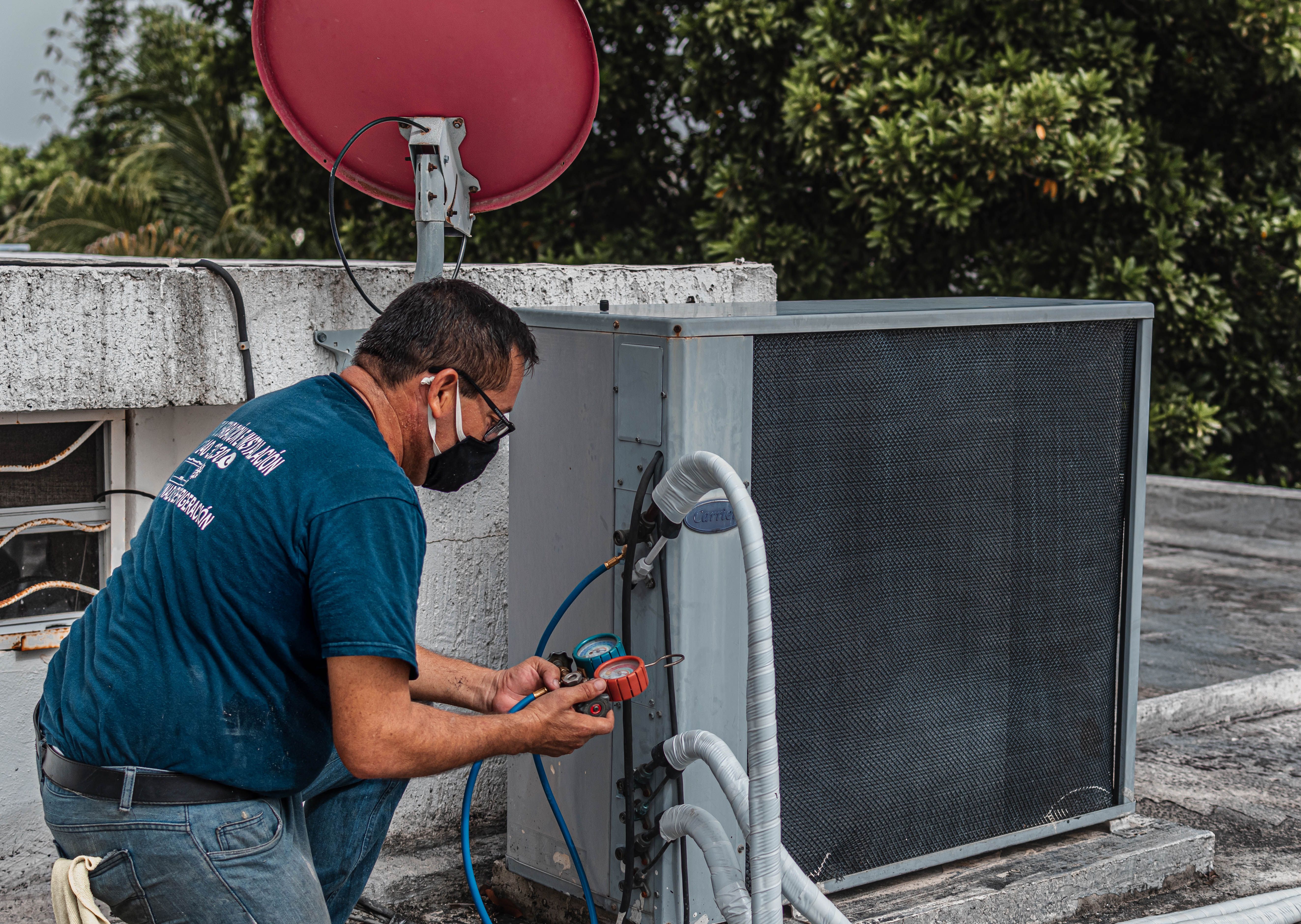
Your AC just died. It's 95°F outside, the humidity is brutal, and you have no idea where to start. Here's exactly what to do, in the right order, to protect your home, your family, and your wallet.
Step 1: Don't Panic. Do a Quick Safety Check First
Before you call anyone or touch anything, rule out a dangerous situation.
- Smell something burning? Shut off the AC unit at the breaker immediately. A burning odor can indicate an electrical fault, melting wiring, or a failing capacitor. Do not attempt to restart it.
- See ice on the refrigerant lines or the indoor air handler? Turn the system off but leave the fan running on "FAN ONLY" mode to let the coils thaw. Running a frozen system damages the compressor, the single most expensive component in your entire unit.
- Hear grinding, screeching, or banging? Power it off at the breaker. Those sounds are mechanical failure in progress.
- Notice water pooling around your air handler? The condensate drain line is likely clogged or the drain pan is cracked. Prolonged leaking causes mold growth and structural water damage, especially in homes with wood framing or finished basements.
If none of the above apply and it simply stopped blowing cold air, proceed to the next steps before calling a technician.
Step 2: Run Through the Basic Homeowner Checklist
A surprising number of "AC failures" are solved in under five minutes without a service call. Check these first:
Power & Electrical
- Check your circuit breaker panel. AC units, especially central systems, trip breakers during power surges or overheating. Reset the breaker once. If it trips again immediately, stop and call a licensed HVAC technician. A double-trip indicates a serious electrical issue.
- Inspect the disconnect box located near your outdoor condenser unit. This weatherproof box contains a pull-out fuse block. Make sure it's fully seated and hasn't been accidentally pulled or damaged.
- Check the thermostat batteries. It's the least glamorous fix but it accounts for more service calls than most homeowners expect.
Thermostat Settings
- Confirm the thermostat is set to COOL, not HEAT or FAN ONLY.
- Set the target temperature at least 5°F below the current indoor reading to trigger a cooling cycle.
- If you have a smart thermostat (Nest, Ecobee, Honeywell Home), check the app for fault codes or alerts, these systems often self-diagnose and will tell you exactly what's wrong.
Air Filter
- A severely clogged air filter is one of the leading causes of sudden AC shutdowns in US homes. The system overheats, the high-limit switch trips, and the unit shuts itself off as a safety measure.
- Pull the filter and hold it up to a light source. If you can't see light through it, replace it before restarting the system. Filters should be replaced every 30–90 days depending on household size, pets, and regional air quality.
Outdoor Condenser Unit
- Walk outside and check the condenser. Is the fan spinning? If the unit is running but the fan isn't turning, the fan motor or capacitor has likely failed.
- Is the unit completely off, no hum, no fan? Check if the condenser coils are visibly dirty or packed with debris (grass clippings, cottonwood seeds, leaves). Restricted airflow causes thermal shutdowns.
- Never pour water directly on a running condenser. You can gently rinse the exterior coils with a garden hose when the unit is powered off.
Step 3: Protect Your Household While You Wait for Service
In high-heat states, Arizona, Texas, Florida, Georgia, and the Carolinas, indoor temperatures can reach dangerous levels within hours during a summer AC failure. Don't wait it out unprepared.
Manage Heat and Humidity Immediately
- Close blinds and curtains on south- and west-facing windows. Direct sunlight can raise indoor temperatures by 10–20°F.
- Move box fans to windows during the cooler hours of the day (before 10 AM and after 8 PM). During peak afternoon heat, closing windows traps cooler air inside better than ventilating.
- Identify the coolest room in the home, typically an interior room on the lowest floor, and consolidate your household there.
- Unplug heat-generating appliances: televisions, gaming consoles, desktop computers, and incandescent lighting all add measurable heat load to a room.
Protect Vulnerable People and Pets
The CDC identifies adults over 65, infants, and people with chronic health conditions as highest risk during heat events. If indoor temperatures climb above 80°F and you cannot ventilate effectively:
- Consider moving to a public cooling center, most US counties activate these during heat advisories. Check your county emergency management website or call 211.
- Keep a close eye on signs of heat exhaustion: heavy sweating, weakness, cold/pale/clammy skin, fast/weak pulse, nausea, or fainting. Heat stroke, hot/red/dry skin, rapid strong pulse, unconsciousness, is a medical emergency. Call 911.
- Pets are equally at risk. Never leave animals in unventilated spaces.
Protect Your Property
- Check your refrigerator and freezer temperatures if you anticipate a multi-hour outage. A full freezer maintains safe temperatures for approximately 48 hours without power; a half-full freezer for about 24 hours.
- If you have a wine cellar, home server room, or any climate-sensitive storage, get a portable AC unit or cooler in place immediately. Electronics and wine collections can sustain serious damage above certain temperature thresholds.
- Document existing conditions with your phone camera, especially any water leakage, ice buildup, or visible damage to equipment. You'll want this if an insurance claim becomes necessary.
Step 4: Call a Licensed HVAC Contractor, the Right Way
This is where most homeowners make costly mistakes. Urgency leads to hasty decisions, and hasty decisions lead to overpriced repairs, unqualified technicians, or unnecessary equipment replacements.
What to Do Before You Call Anyone
- Write down your system's make, model, and approximate age. This information is on the data plate attached to both the indoor and outdoor units. An older system (12–15+ years) changes the cost-benefit conversation around repair vs. replacement significantly.
- Note your home's square footage and the system's tonnage if you can find it. Undersized or oversized replacements are a common upsell that happens when consumers aren't prepared.
- Check if your equipment is under manufacturer warranty or an extended service plan. Many HVAC brands offer 5–10 year parts warranties. Calling the wrong contractor could void it.
Questions to Ask Before Booking a Technician
Don't skip these. A reputable company will answer every one without hesitation.
- "Are you licensed in [your state]?", HVAC licensing requirements vary significantly by state. In states like Texas, California, Florida, and New York, a valid state license is legally required to perform HVAC work. In others, only a local municipality license or EPA 608 certification is required. Know your state's rules before the tech walks in your door.
- "Are your technicians EPA 608 certified?", Federal law requires anyone who purchases or handles refrigerants (Freon/R-22, R-410A, R-32) to hold an EPA Section 608 certification. Handling refrigerants without this certification is illegal and a serious red flag.
- "Do you carry general liability insurance and workers' compensation?", A technician injured on your property without workers' comp becomes your financial problem. Get proof of insurance before work starts, not after.
- "Will you provide a written diagnostic fee and written estimate before any repair work begins?", Any reputable contractor will. Anyone who refuses to put it in writing before starting is a warning sign.
- "Is this a flat-rate or time-and-materials quote?", Understanding how you're being charged prevents unexpected invoice inflation.
- "Do you offer any warranty on labor?", Industry standard for labor warranties ranges from 30 days to one year. If a company offers nothing, that's a red flag.
Red Flags That Signal a Bad Actor
- Demands cash payment upfront for the full job amount
- Cannot or will not provide a license number when asked
- "Finds" major issues immediately without running a full diagnostic
- Pressures you toward full system replacement on the first visit without a second opinion option
- Arrives in an unmarked vehicle with no company identification
- Has no physical business address, only a mobile number
Step 5: Understand the Estimate and Your Consumer Rights
Before anyone starts work, you have specific rights as a homeowner, and knowing them keeps you in control.
Reading the Estimate
A proper HVAC repair estimate should include: - Itemized parts costs with part numbers where applicable - Labor rate and estimated hours - Diagnostic fee and whether it's credited toward the repair if you proceed - Total cost with any applicable taxes - Payment terms, deposit amount (if any), when final payment is due
Your Right to a Second Opinion
You are never obligated to approve a repair on the spot. If a technician quotes you a repair in excess of $500–$1,000, getting a second diagnostic opinion is financially prudent, especially if replacement is being recommended. A diagnostic fee for a second visit ($75–$150 in most US markets) is well worth the money against a $5,000–$15,000 system replacement decision.
Understanding Common Repair Cost Ranges (US National Averages)
| Repair Type | Typical Cost Range |
|---|---|
| Capacitor replacement | $150–$400 |
| Contactor replacement | $150–$350 |
| Refrigerant recharge (R-410A) | $200–$500 |
| Blower motor replacement | $300–$700 |
| Condensate drain line clearing | $75–$250 |
| Evaporator coil replacement | $650–$2,500 |
| Compressor replacement | $1,200–$2,800 |
| Full system replacement (central AC) | $3,500–$12,500+ |
Prices vary by region, equipment brand, and local labor market. Urban markets in California, New York, and the Northeast typically run 20–40% higher than national averages.
How to Verify a Contractor's Credentials: 3 Trusted US Platforms
Before you hand over access to your home and write a check, take 10 minutes to verify who you're dealing with. These three platforms are the most reliable tools available to US homeowners.
Better Business Bureau (BBB) — bbb.org
The BBB has tracked US business complaint histories and accreditation standards for over 100 years. Here's how to use it effectively:
- Search by business name and zip code to find the specific local entity, not a national franchise umbrella.
- Review the complaint history section carefully. The rating itself (A+ through F) matters less than the pattern of complaints. A business with 15 complaints that resolved them all is often more trustworthy than one with a pristine rating and zero reviews.
- Check accreditation status. BBB-accredited businesses have agreed to binding arbitration for unresolved disputes, a meaningful consumer protection that non-accredited companies don't offer.
- Look at the "years in business" field. Fly-by-night contractors rarely maintain a BBB profile over multiple years.
Angi (formerly Angie's List) — angi.com
Angi is one of the largest US home services marketplaces, with verified reviews and contractor background checks built into the platform.
- Filter specifically for HVAC contractors in your zip code and sort by rating and number of reviews, not just star rating. A contractor with 4.6 stars and 200 reviews is more reliable data than one with 5 stars and 3 reviews.
- Read the negative reviews first. The complaints tell you more than the praise. Look specifically for patterns around billing disputes, no-shows, or incomplete work.
- Use Angi's "background checked" filter. Contractors on the platform can submit to identity and criminal background checks. While not a substitute for license verification, it's an additional data point.
- Request quotes directly through the platform for a paper trail of communication, valuable if a dispute arises later.
State Licensing Boards, Verify Directly with Your State
This is the single most important verification step, and the one most homeowners skip.
Every US state that requires HVAC licensing maintains a publicly searchable online database where you can verify a license number in real time. These databases tell you:
- Whether the license is active and current
- Whether any disciplinary actions, suspensions, or complaints have been filed
- The specific trade classifications the license covers
- The bond and insurance requirements the contractor has met
How to find your state's licensing board: Search "[Your State] HVAC contractor license lookup", most states maintain this through their Department of Consumer Affairs, Department of Labor, or a dedicated Contractor State License Board (California's CSLB is one of the most robust in the country).
Key states and their licensing bodies: - California: Contractors State License Board, cslb.ca.gov - Florida: Department of Business and Professional Regulation — myfloridalicense.com - Texas: Air Conditioning and Refrigeration Contractors Advisory Board — tdlr.texas.gov - New York: Department of Labor — labor.ny.gov
Ask the contractor for their license number before they arrive, then verify it yourself in under two minutes.
Filing a Complaint If Something Goes Wrong
If a contractor performs substandard work, abandons the job, or defrauds you, you have recourse:
- File with your State Licensing Board — this triggers an investigation and can result in license suspension or revocation.
- File with your State Attorney General's Consumer Protection Division — particularly effective for fraud, deceptive pricing, or bait-and-switch tactics.
- File a BBB complaint — especially effective for accredited businesses who are contractually obligated to respond.
- Dispute the charge with your credit card company if you paid by card — this is another strong reason to never pay in cash.
- Small Claims Court is a realistic option for disputes under $5,000–$10,000 (limits vary by state) without needing an attorney.
Find Qualified Local HVAC Professionals in Your Area
A national guide gets you prepared. Local expertise gets the job done.
HVAC service quality, licensing requirements, seasonal demand, and pricing vary significantly from state to state and city to city. A contractor who performs excellent work in Phoenix may not even be licensed to operate in California. Labor rates in rural Georgia look nothing like those in metro Chicago.
When you're ready to find a vetted, licensed HVAC technician in your specific area, search regional directories and local subdomains that specialize in matching homeowners with screened professionals in their exact market. Look for platforms that list verified license numbers, carry proof of insurance requirements, and publish real customer reviews from your community, not generic national aggregators that mix zip codes indiscriminately.
The right technician for your home is local, licensed, insured, and verifiable. Now you have exactly what you need to find one, and the knowledge to make sure they're doing the job right.